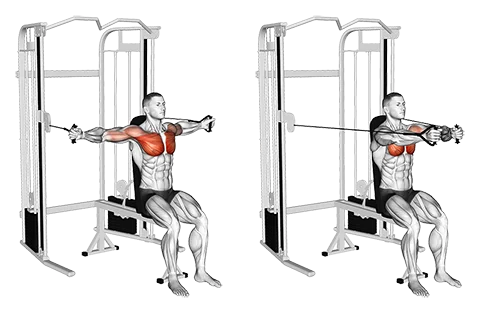
The seated cable chest fly is a controlled, tension-filled way to train your chest—especially the inner and mid fibers. Compared to dumbbells, cables provide constant resistance throughout the movement, making it easier to focus on muscle contraction and form.
It’s great for lifters of all levels looking to build muscle, improve symmetry, or add volume without taxing the joints.
Muscles Worked
- Primary: Pectoralis major (especially inner and mid-chest)
- Secondary: Front delts, biceps (as stabilizers)
The seated position limits body movement, helping isolate the chest and reduce momentum.
How to Do It (Step-by-Step)
- Adjust the seat and cable handles so the pulleys are at chest height when seated.
- Sit upright with your back flat against the pad, feet planted.
- Grab the handles with palms facing forward or slightly inward.
- With a slight bend in your elbows, bring the handles together in front of your chest.
- Squeeze at the top, then return slowly to the starting position until you feel a deep stretch.
💡 Keep the motion smooth—don’t let the weights pull your arms back too fast.
Ideal Rep & Rest Ranges
| Goal | Reps | Rest |
|---|---|---|
| Hypertrophy | 10–15 | 30–60 sec |
| Endurance | 12–20 | 15–45 sec |
Pair this with Auto Progression to hit ideal rep targets and adjust over time.
Form Tips
- Elbows slightly bent: Lock in this angle and avoid turning the fly into a press.
- Stay upright: Don’t lean forward or twist—stay locked into the seat.
- Stretch with control: Let your pecs open up at the bottom, but avoid over-stretching.
- Focus on the squeeze: Visualize your pecs pulling the handles together.
When to Use It
- Toward the end of your chest workout for isolation
- In supersets with pressing movements
- On cable-based push days where control is the focus
Common Mistakes
- ❌ Using too much weight and losing control
- ❌ Turning it into a press (bending the elbows mid-rep)
- ❌ Leaning forward or swinging the body
- ❌ Not allowing a full range of motion
📌 Lighter weight, perfect form = better pec activation.
Why You Don't Feel It in Your Chest (And How to Fix It)
This is one of the most common problems with the dumbbell chest fly — and it's almost always a form issue, not a muscle issue.
You're bending your elbows too much
The moment your elbows bend past a slight angle, the movement turns into a press. Your triceps take over, and your chest checks out. Keep a fixed, soft bend — think of your arms as hooks, not levers.
You're going too heavy
Heavy dumbbells force you to recruit everything available — shoulders, biceps, whatever it takes. Drop the weight by 20-30% and focus entirely on the stretch. You should feel your chest pulling open at the bottom of the movement.
Your shoulder blades aren't set
Before you start, pull your shoulder blades together and down into the bench. Keep them there throughout the entire set. This locks your shoulders out of the movement and forces your chest to do the work.
You're rushing through the stretch
The chest fly only works if you actually feel the stretch at the bottom. Lower slowly — 3 to 4 seconds down — pause for a beat when your elbows are level with your chest, then squeeze your pecs to bring the weights back up. If you're not pausing at the bottom, you're leaving the most important part of the rep on the table.
Quick checklist before your next set
- Dumbbells light enough to fully control
- Elbows at a fixed, soft bend throughout
- Shoulder blades pinched and pressed into the bench
- 3-4 second descent, pause at the bottom
- Squeeze your chest — not your hands — to bring the weights up
Progress with Volym
- Set progression targets using Auto Progression
- Record your performance with Workout History
- Use the Rest Timer to control fatigue and manage intensity
The Importance of Constant Tension
Most people approach fly movements thinking it's just about moving the weight from point A to point B. That’s wrong. The effectiveness of the seated cable fly comes from constant tension—the fact that the resistance is applied throughout the entire range of motion, not just at the start or the finish.
This is fundamentally different from free weights (dumbbells) where tension drops off when your muscles fatigue or the movement becomes easier.
When tracking isolated movements, you aren't just counting reps; you're measuring the total tonnage applied through perfect form. This means tracking the entire work cycle, not just the number of sets logged.
To maximize this movement:
- Control the Eccentric (Stretch): Use time (e.g., 3–4 seconds) to lower the weight. This creates the stretch under tension, which is where most muscle damage (and subsequent growth) occurs.
- Brace at the Peak (Squeeze): At the top, don't just stop. Actively squeeze the pecs and hold the contraction for a visible beat. This teaches the muscle to contract fully.
- Maintain Tension: Never let the weight "dump" or "stick." The tension must be present from the beginning, through the midpoint, and right until you reach the peak contraction.
Cables provide constant tension throughout the movement, making them great for controlled isolation work and a better peak contraction.
No. This movement works best with moderate weight and perfect form. Focus on the stretch and squeeze.
Yes! You can adjust the pulley height to hit different areas of the chest (e.g., higher for lower chest, lower for upper chest).
A little front delt involvement is expected, but if your shoulders dominate, lighten the weight and check your form.
Absolutely. The seated position adds stability and makes it easier to focus on proper chest activation.