
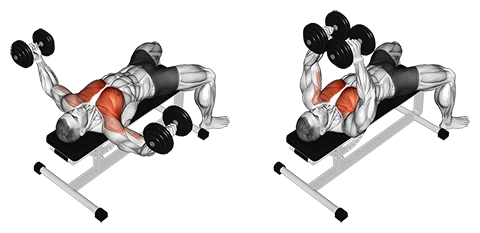
The dumbbell chest fly is a classic chest isolation exercise that delivers a deep stretch and strong contraction in the pecs. Unlike presses, flies reduce triceps involvement, letting your chest do most of the work.
Perfect as a finisher or mid-workout stretch movement, flies can help improve mind-muscle connection and overall chest growth.
Muscles Worked
- Primary: Pectoralis major (chest)
- Secondary: Front delts, biceps (stabilization), serratus anterior
The goal is to open up the chest and maximize the range of motion—without turning it into a press.
How to Do It (Step-by-Step)
- Lie flat on a bench with a dumbbell in each hand, arms extended above your chest with a slight bend in your elbows.
- Slowly lower the dumbbells out to your sides in a wide arc, keeping your elbows fixed.
- Stop when your elbows are level with your chest or slightly below, feeling the stretch in your pecs.
- Squeeze your chest to reverse the motion, bringing the dumbbells back together at the top.
💡 Keep the movement smooth and controlled—this isn’t about moving heavy weight fast.
Rep Ranges for Chest Goals
| Goal | Reps | Rest |
|---|---|---|
| Hypertrophy | 10–15 | 30–60 sec |
| Endurance | 12–20 | 15–45 sec |
You can include dumbbell flies toward the end of your chest workout, once your pressing movements are done.
Form Tips
- Slight bend in the elbows: Lock that angle in and keep it consistent.
- Don’t go too deep: Stop once you feel a strong stretch—going further can strain your shoulders.
- Neutral wrist position: Keep wrists straight and avoid rotating inward.
- Squeeze at the top: Focus on contracting your pecs, not just tapping the dumbbells together.
When to Use Dumbbell Flies
- After compound chest exercises to stretch and fatigue the pecs
- In superset combos with push-ups or presses
- On pump days where lighter weight and control are the focus
Common Mistakes
- ❌ Turning it into a press (elbows bending too much)
- ❌ Dropping the dumbbells too far and straining shoulders
- ❌ Rushing through the rep and skipping the stretch
📌 Go light, go slow, and feel every rep.
Progress Smarter with Volym
Use Volym’s tools to level up your fly game:
- Enable Auto Progression to hit ideal targets without guesswork
- Add Rest Timer to manage recovery for higher-rep sets
- Log every detail using Workout History to track improvements over time
Progressive Overload for Isolation Movements
Progressive overload isn't just about adding weight. It's about increasing the total work done over time. For an isolation movement like the dumbbell fly, volume plateaus happen easily because you can manipulate reps, sets, and time under tension without massive weight jumps.
To truly overload the pecs, you need to track the total volume (sets × reps × weight). Instead of just hitting 3 sets of 12 reps at 20 lbs this week, you need to see if last week’s total tonnage was higher.
Look beyond the weight. Focus on increasing the total volume (sets × reps × weight) or improving the consistency of your reps week over week. That's the only way you guarantee progression.
Focus on two metrics: either adding weight, or adding total volume (tonnage) by increasing reps or sets while maintaining solid form.
Tonnage is better. It accounts for sets, reps, and weight, giving you a true picture of total work load—that’s the only thing that guarantees overload.
If form drops, decrease weight and focus on hitting the top end of your rep range consistently. If form is perfect, slightly increase the weight next week.